IDAS (Integrated Data Acquisition System)
Professional Software Platform for Control, Automation, and Advanced Analysis in Mechanical Impact Testing
The IDAS (Integrated Data Acquisition System) software represents the state of the art in high-precision control interfaces for testing laboratories and certification centers. Developed by GTM and AD Engineering , IDAS coordinates the entire measurement and motion sequence of drop towers used for impact testing on helmets (motorcycle, bicycle, ski) and personal protective equipment. By interfacing directly with the proprietary QASM7 electronic board, the software simultaneously manages automated mechanical movement of heavy carriages and high-frequency analog data acquisition.
1. System Architecture, Safety, and Hardware Integration
The software is designed to ensure maximum operational efficiency with minimal manual intervention, drastically reducing setup times between tests:
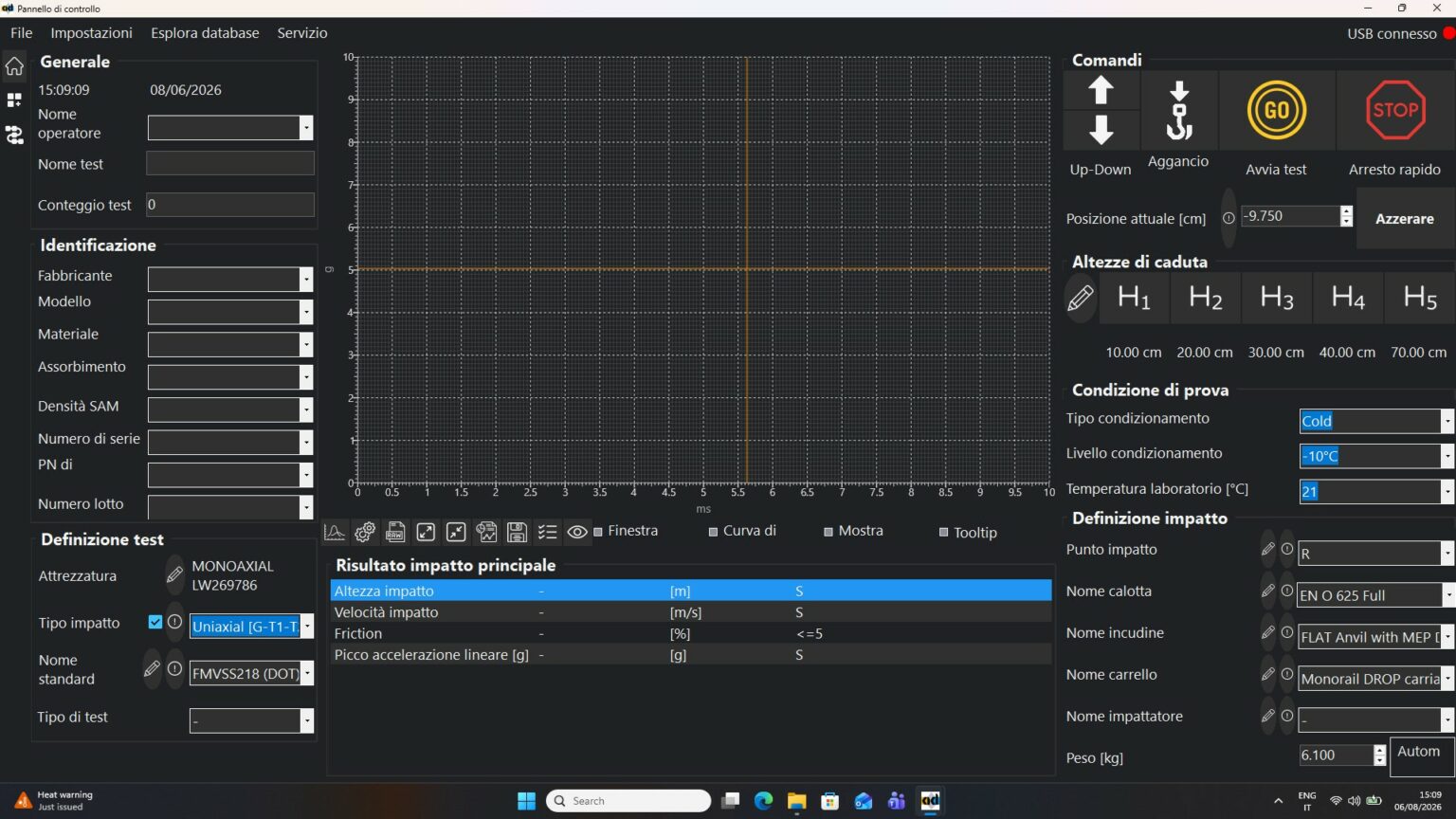
- Plug-and-Play Connectivity & DTS Architecture: Upon startup, the system automatically scans USB ports to recognize and link the testing machine. It natively supports both wired and Wireless DTS (Data Acquisition System) configurations, monitoring live signal strength (RSSI), battery levels, and sensor sleep states in real time.
- Active Safety and Diagnostic Semaphores: The interface features a LED “semaphore” system that prevents accidental carriage drops or test initialization unless all safety requirements are met (e.g., carriage securement or hardware integrity). The system instantly detects physical Emergency Stop (E-Stop) activation, immediately halting all operations.
- Custom Machine Profiles (Equipment Creation): Users can create and save specific hardware configurations. You can customize the sampling frequency (e.g., 50,000 Hz) and configure the ring buffer by defining the exact number of Pre-Trigger and Post-Trigger samples up to a total limit of 65,535.
2. Kinematic Management and Mechanical Drop Control
IDAS is not just a data recorder, but a true cinematic control hub for the testing tower:
- Automated Drop Heights: From the main dashboard, operators can command manual and automatic positioning (Up/Down, Auto-Hook). Through the dedicated configurator, you can predefine up to 5 drop heights (H1–H5), automatically calculated based on the specific speed or impact energy required by the test.
- Inertia and Friction Compensation: It includes parameters to configure upward and downward braking advance in centimeters. This feature compensates for mechanical inertia from the drive motor, ensuring precise positioning and preventing overshooting.
- Velocity Loss Calculation: As the carriage passes through the photocell gates (Blades Distance), the system registers 4 signal edge transitions to calculate the exact real instantaneous impact velocity. By comparing this with the theoretical velocity (\(v = \sqrt{2gh}\)), the system quantifies mechanical friction during free fall.
3. Sensor Support and Complex Biaxial Configurations
The core calculation engine of IDAS is structured to manage complex multi-axis measurement chains:
- Supported Sensors: Manages calibration and sensitivity values for triaxial accelerometers, gyroscopes (ARS for angular velocity), load cells, and linear compression/position sensors.
- Advanced Biaxial Electronics: Supports special “two-wire” configurations where one sensor is mounted on the moving carriage and another on the fixed anvil or dummy headform. It handles combined systems such as accelerometers + load cells, dual linear accelerometers, or accelerometers + position sensors.
- Direct vs. Indirect Measurement Logic: When a load cell is active, the software automatically converts the acquired force curve (in Newtons) into an equivalent acceleration curve expressed in g, scaled to the falling mass. It utilizes an intelligent assignment logic, prioritizing direct physical sensor measurements over mathematically derived indirect calculations.
4. Post-Impact Diagnostics and Advanced Analysis Tools
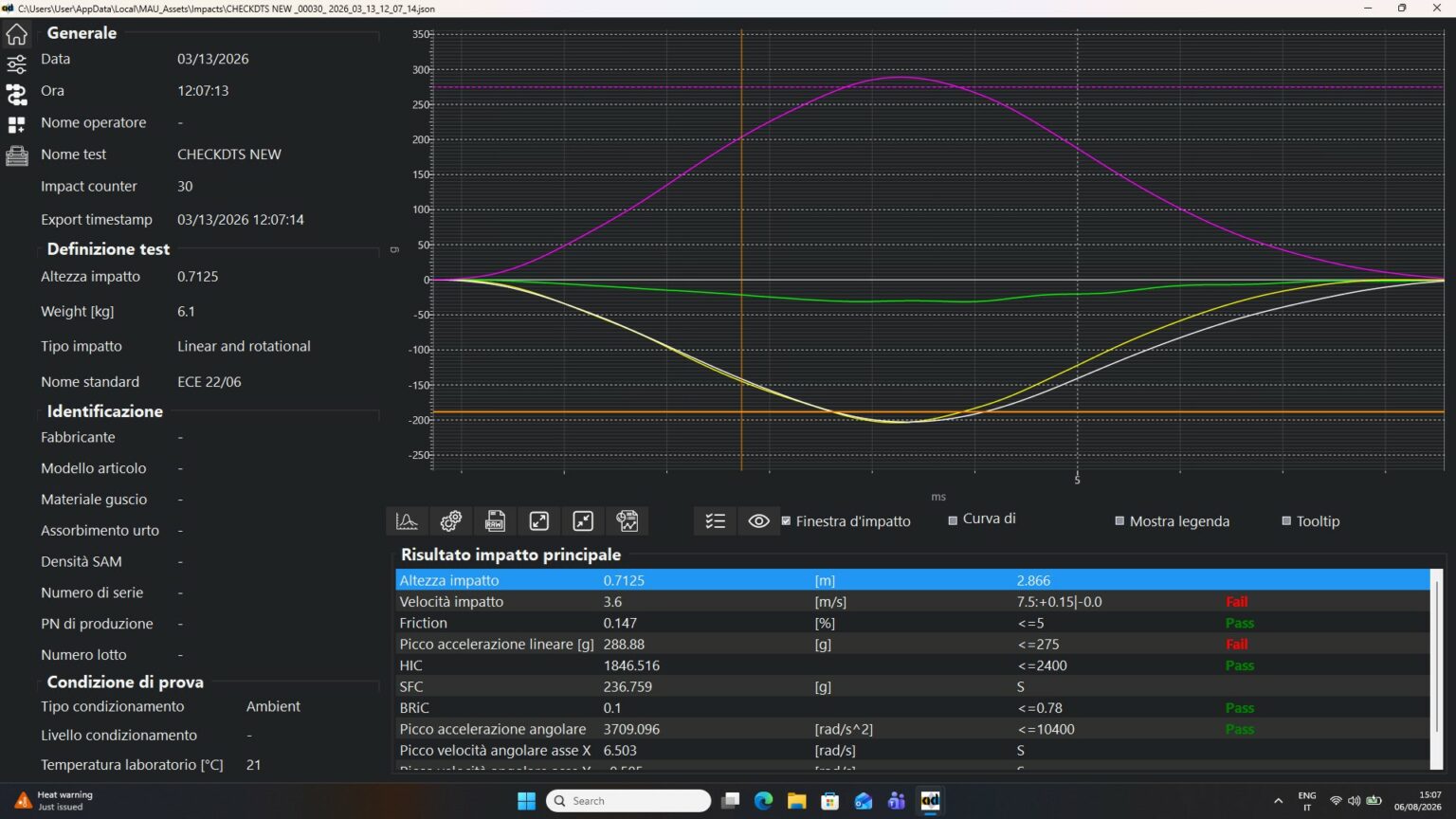
Immediately after completing the 12-step impact execution sequence, IDAS populates the dashboard with real-time waveform graphs:
- Advanced Analysis Interface: Allows millimeter-accurate zooming on impact peaks, interactive tooltips, and individual channel isolation (CH 1–8) to verify signal integrity in millivolts (mV) or isolate background noise.
- CFC Filtering and Bode Analysis: Integrates customizable Butterworth CFC digital filters (Cut-off, Order, Direction) essential for regulatory compliance, allowing the generation of dedicated Bode filter analysis reports.
- Biomechanical Index Calculation: The software automatically computes the Linear Acceleration Peak, HIC (Head Injury Criterion), transmitted force, material compression space, and oblique impact vectors (angular velocity, rotational acceleration, and the BRiC index).
5. Database, Traceability, and Compliance Reporting
Data management is fully structured to meet the strict traceability requirements of ISO/IEC 17025 accredited laboratories:
- Total Traceability (Registries and Catalogs): Every test is recorded by linking results to metadata entered by the operator: operator name, lot number, serial number, shell material (e.g., ABS, Fiber), laboratory temperature, and environmental conditioning type (Ambient, High/Low Temperature, Ageing).
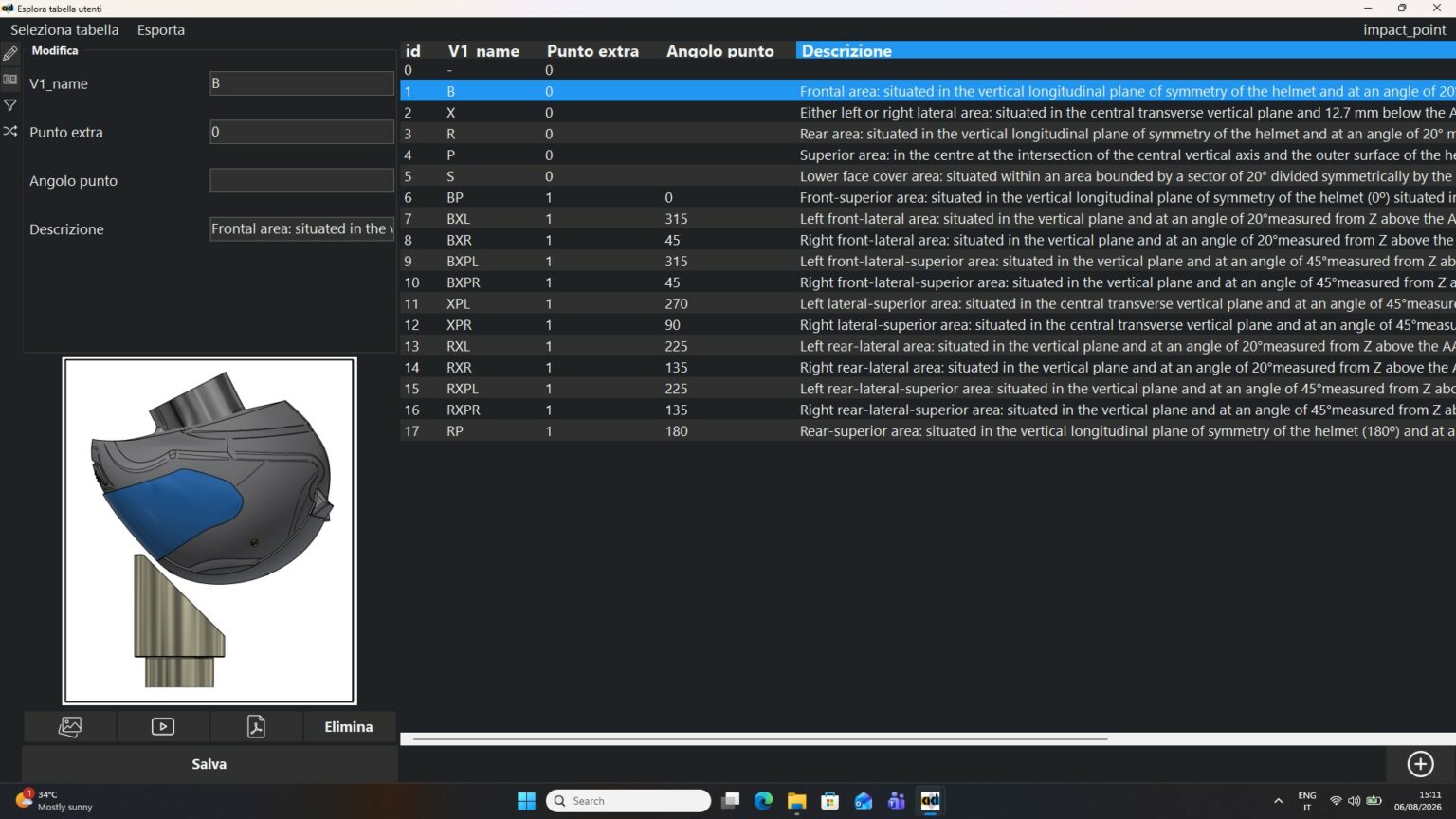
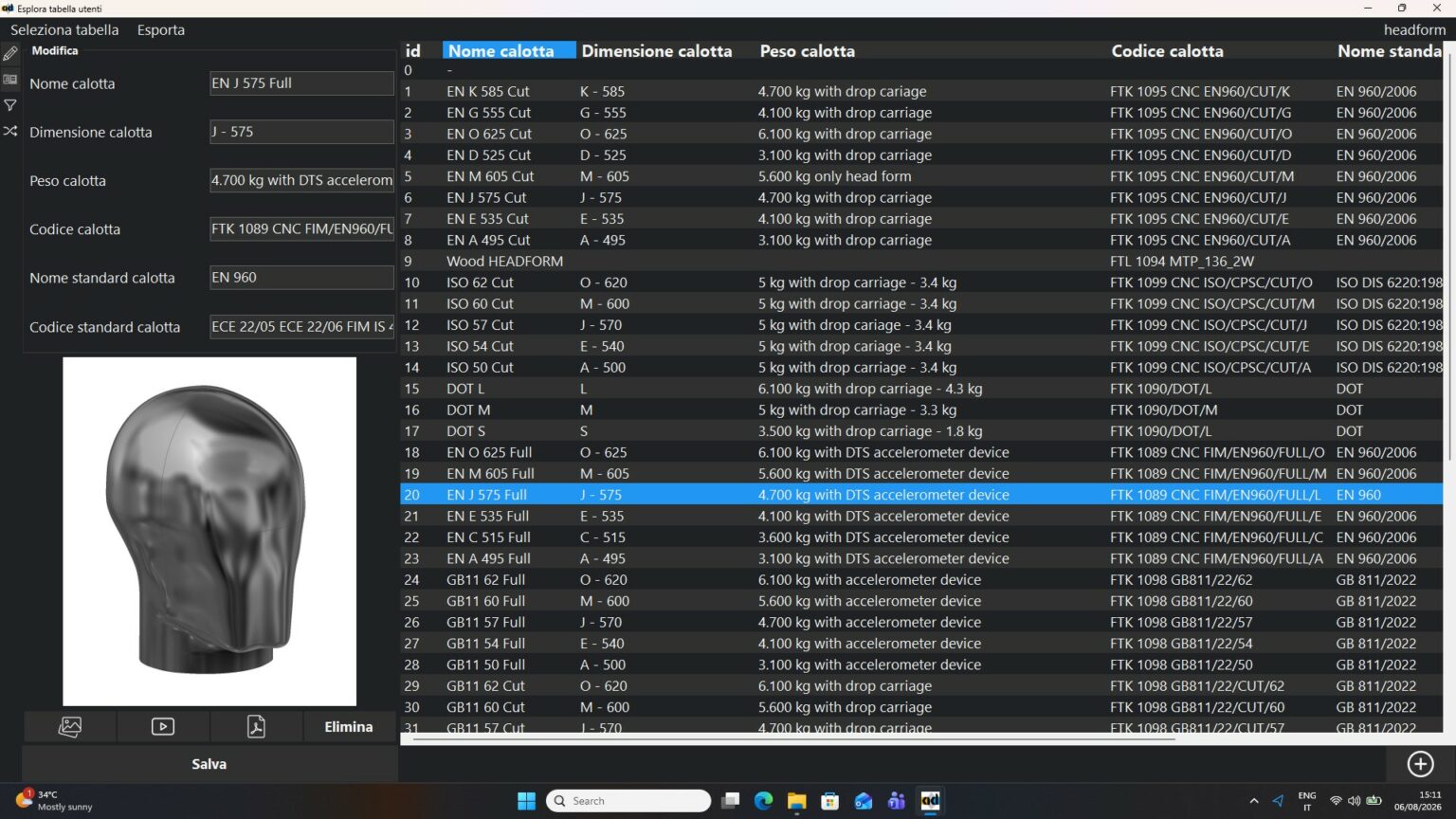
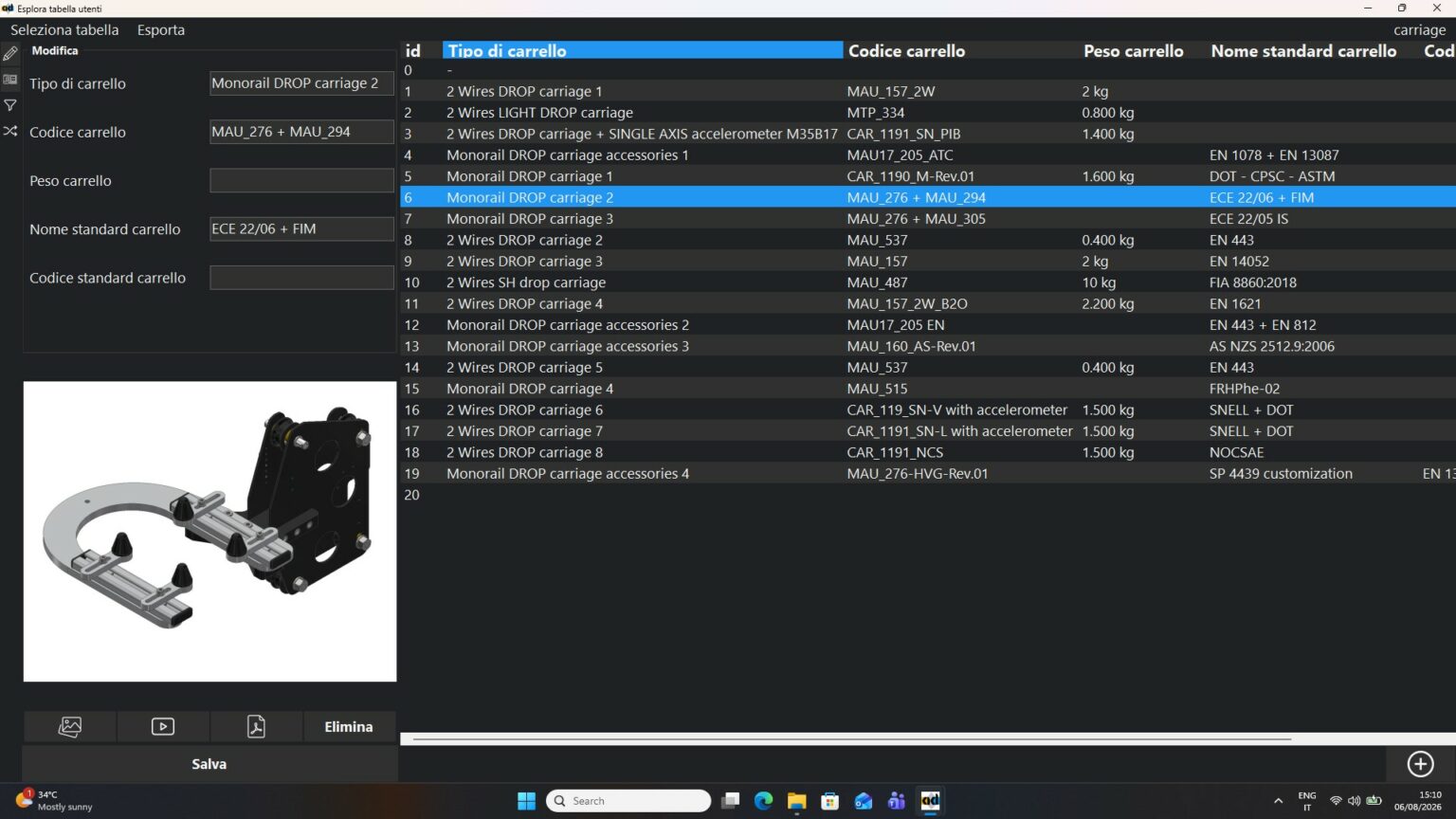
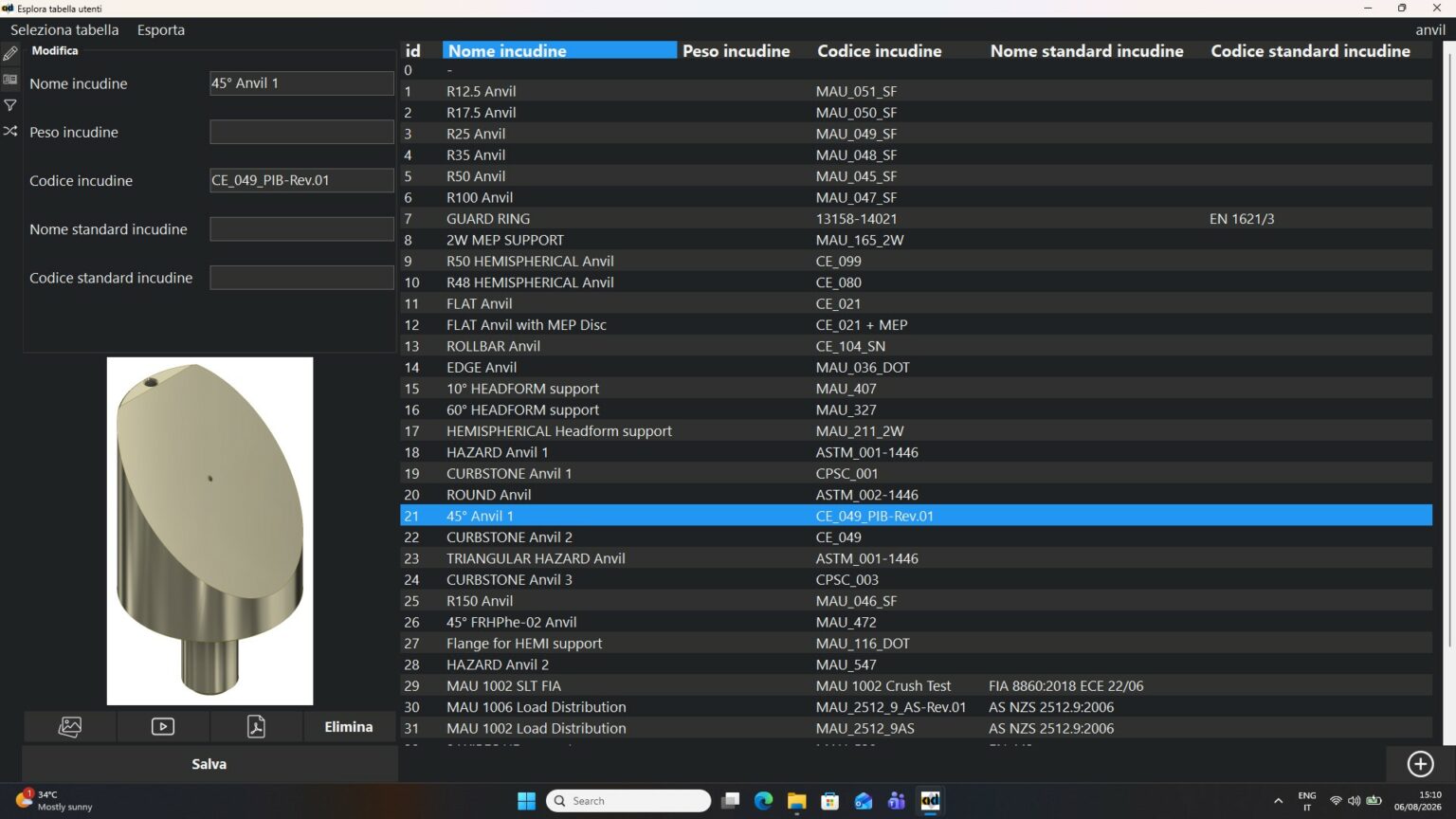
- Impact Explorer (Centralized Database): A powerful cataloging tool allows you to chronologically organize, search, and filter thousands of historical tests, customizing column visibility to focus strictly on relevant metrics.
- Export and Fast Report: In addition to automatic local saving and native export to standard JSON files for external sharing, IDAS includes tools for immediate compliance report generation. Reports can be exported to PDF or Excel, choosing between “Lite” summary templates or “Full” versions with extensive multi-axis graphs.